A production-ready Flutter template on Clean Architecture that you configure, not rebuild.
Auth with token refresh, a pinned HTTP layer, secure storage, routing, localization, theming and three tiers of tests are already wired together and tested. Every external service sits behind a small contract with a no-op default, so pointing the app at your backend and providers takes configuration and an adapter, not a rewrite.




Use this template · Getting started · Documentation · Releases
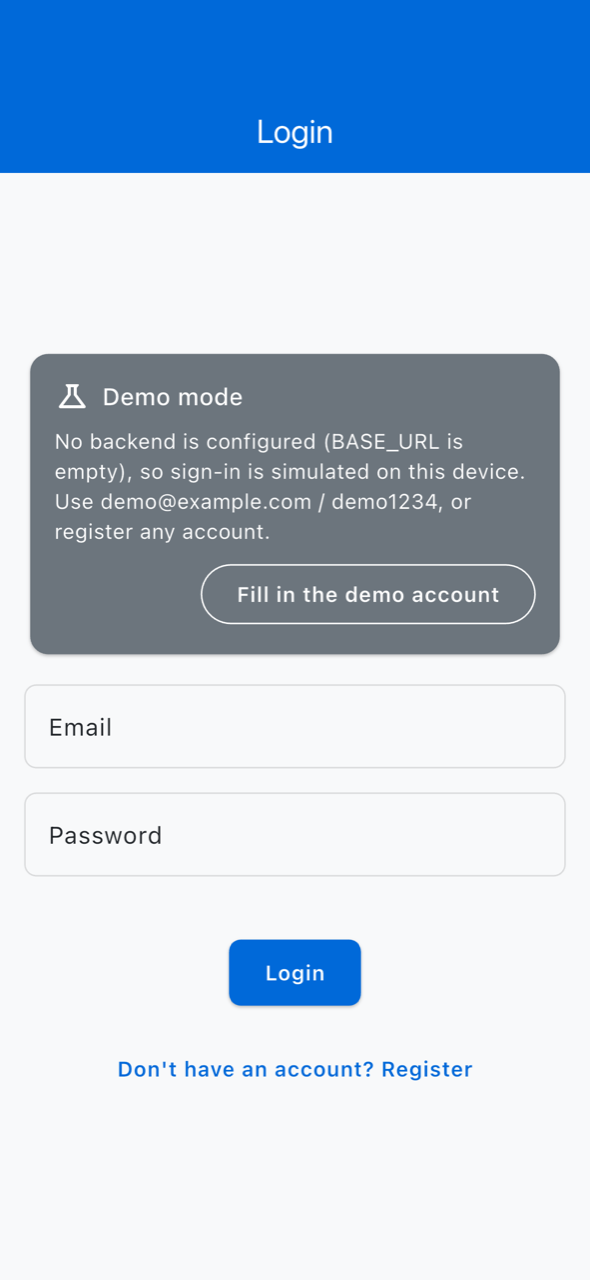
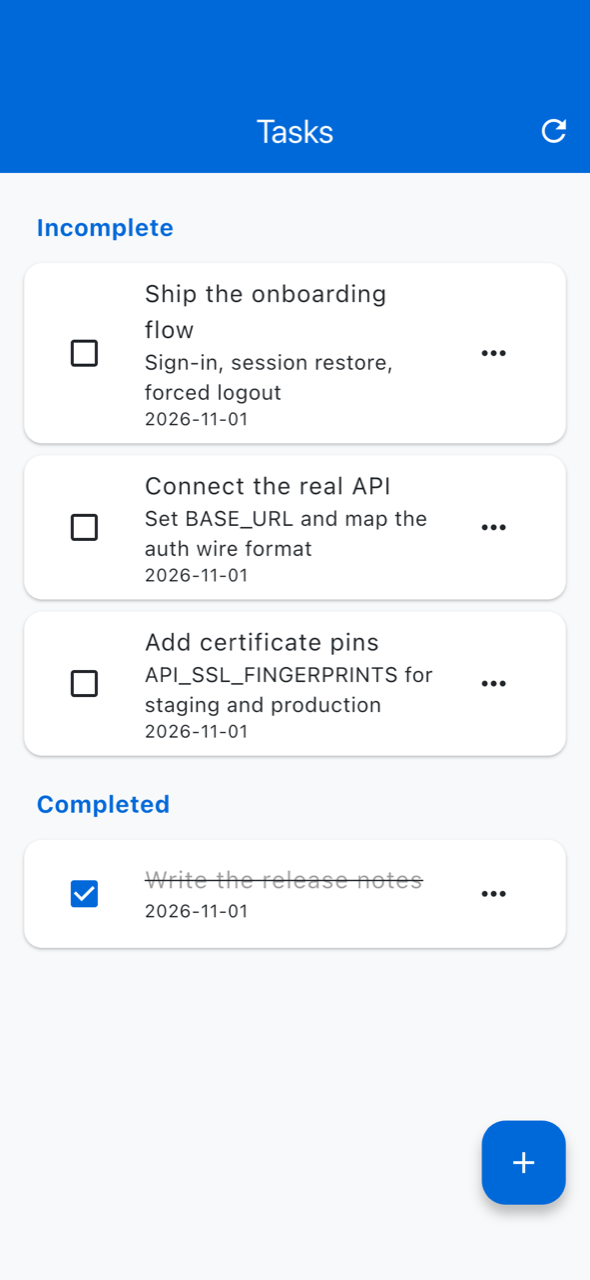
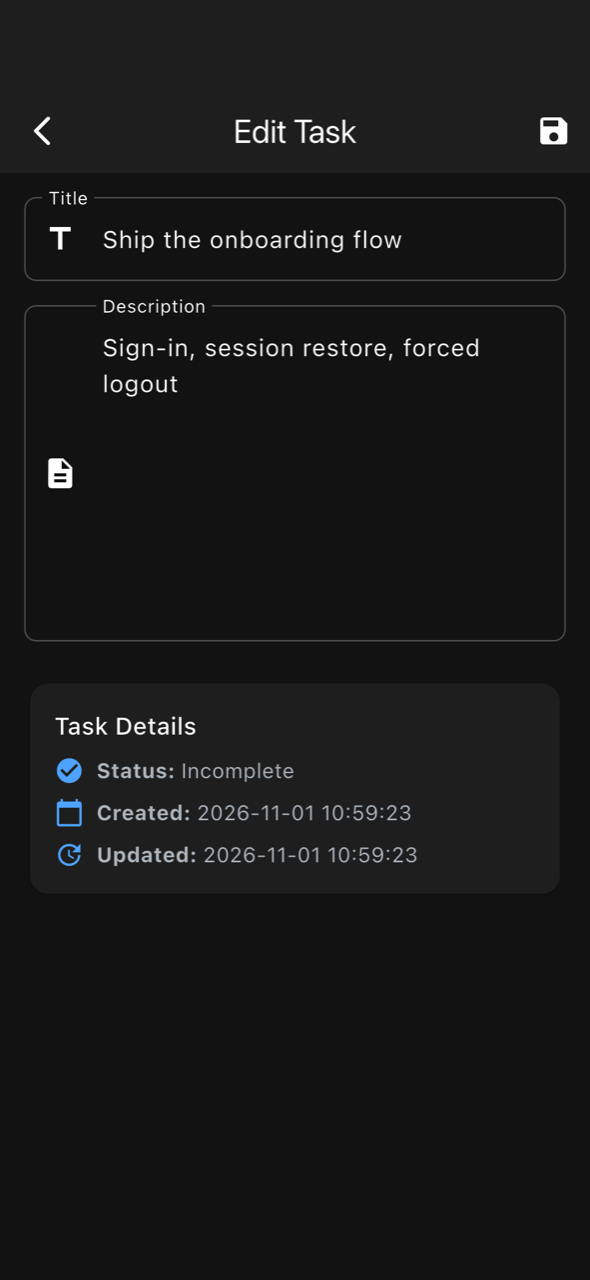
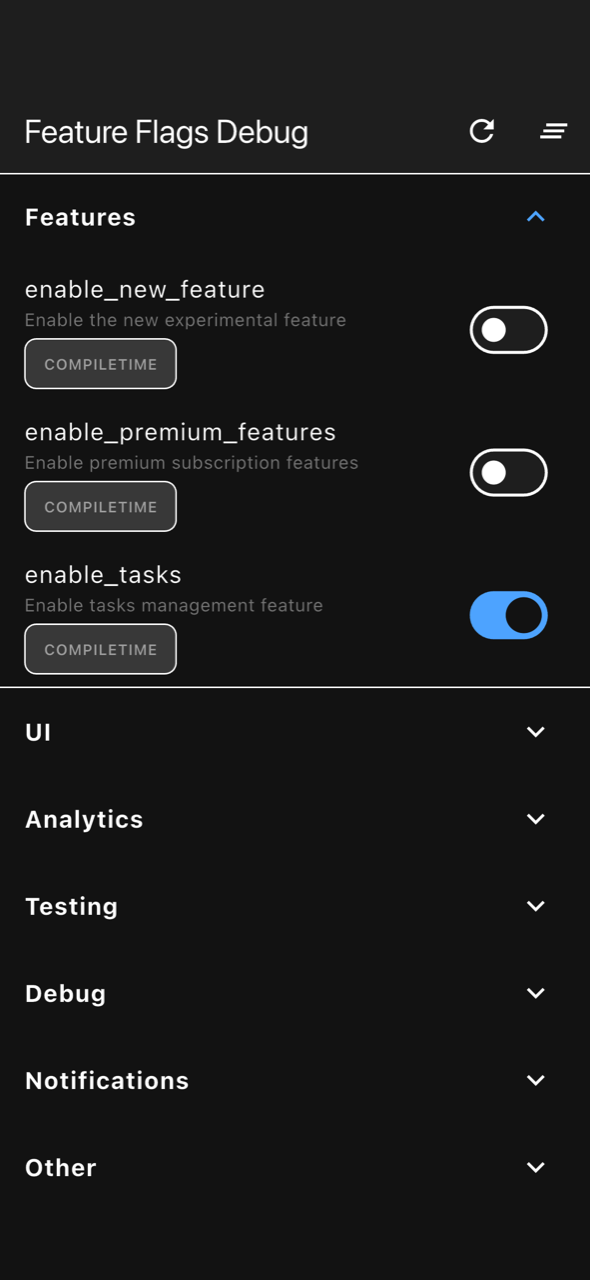
Captured on the iOS Simulator in light and dark mode, with no backend configured. The same code builds for Android, the web and desktop.
- Runs before you have a backend. Until you set
BASE_URL, a debug build signs in offline with a demo account, so the whole app works end to end on day one. Setting it turns the demo off. - No vendor lock-in. Storage, networking, error reporting, performance tracing and RASP each sit behind a contract with a no-op or local default, and the Crashlytics, Firebase Performance, freeRASP and GraphQL integrations ship as templates rather than dependencies (Contracts and adapter map).
- Safe release builds. A staging or production build refuses to start on
a development configuration, a
BASE_URLthat is not https, or certificate pinning with no fingerprints, instead of shipping quietly misconfigured. - Verified, not assumed. Every pull request runs format, analysis with
very_good_analysis, the full test suite under a 94% line coverage floor, and checks that the docs' code, paths and commands still match the code (Quality gates). - Yours in a few commands. A Mason brick renames the package, app name and application ids, and one command removes the sample features (Using this template).
flutter pub get                    # Flutter 3.47+ (Dart 3.13+)
./scripts/dev/setup_git_hooks.sh   # format and analyze on commit, Conventional Commits
flutter run                        # no BASE_URL yet: sign in with the demo account
pubspec.lock is resolved on the current stable Flutter. On an older 3.47+
SDK, flutter pub get rewrites a few SDK-pinned entries in it; that diff is
your SDK's, not the project's, so do not commit it.
To point the app at your API, copy the example environment file, set
BASE_URL in it, and pass it to the build:
cp .env.example .env
flutter run --dart-define-from-file=.env
.env is a build input, never a Flutter asset, so it does not ship inside the
app. Without --dart-define-from-file, flutter run uses the built-in
development defaults.
Generated code (Freezed, json_serializable, Riverpod) is committed; run
flutter pub run build_runner build --delete-conflicting-outputs only after
changing an annotated source. Details, platforms and troubleshooting:
Getting started.
| Area | What is in place | Docs |
|---|---|---|
| Architecture | Domain, data and presentation layers per feature, Riverpod for state and dependency injection, contracts in lib/core/contracts with adapters alongside |
Architecture |
| Auth and session | Sign-in and registration, token refresh with retry, session restore on launch, forced logout; tokens in the iOS Keychain / Android Keystore | Auth repositories |
| Networking | Dio behind a transport-agnostic client, the token sent only to the API's own origin, certificate pinning, an HTTP cache, redacted logs, and a WebSocket realtime client | Security |
| Configuration | .env layering, --dart-define and per-environment defaults; a release build checks its configuration at startup |
Configuration |
| Routing | go_router with signed-in and signed-out guards and a not-found screen | Routing |
| UI | Material 3 design tokens with light and dark themes, accessibility helpers, and English, Spanish, Arabic (RTL) and Vietnamese | Internationalization, Accessibility |
| Observability | A logging service, plus error-reporting and performance seams with no-op defaults | Performance |
| Tests | Unit and widget tests mirroring lib/, acceptance goldens, and Patrol end-to-end tests |
Testing |
| Tooling | Git hooks, CI, feature scaffolding, release scripts, fastlane lanes and deploy workflows | Deployment |
| Sample: tasks | A complete removable slice: local create, edit, complete and delete | lib/features/tasks |
| Sample: feature flags | A complete removable slice: compile-time and local flags with a debug screen | lib/features/feature_flags |
| Layer | Choice |
|---|---|
| Framework | Flutter 3.47+, Dart 3.13+ |
| State and DI | Riverpod 3 with code generation |
| Navigation | go_router 18 |
| Networking | Dio 5, web_socket_channel for realtime |
| Models | Freezed 4, json_serializable |
| Storage | flutter_secure_storage 11 for tokens, shared_preferences for the rest |
| Localization | flutter_localizations and intl, ARB files |
| Testing | flutter_test, mocktail, Patrol |
| Tooling | very_good_analysis, Mason, fastlane, GitHub Actions |
lib/core/          the foundation: config, network, session, storage, routing, logging, security
lib/features/<f>/  one slice per feature: domain/, data/, presentation/, di/, routing/
lib/shared/        design system, theme, shared widgets
test/              unit and widget tests, mirroring lib/; acceptance goldens in test/acceptance/
integration_test/  Patrol end-to-end tests
scripts/, tool/    developer, CI and release scripts; docs and repository checks
Presentation and data depend on domain, and domain depends on neither. See Understanding the codebase.
Every pull request runs the Quality gate:
- format, and
flutter analyzewithvery_good_analysis; - the full test suite in random order, with a 94% total line coverage floor;
- a check that
flutter pub getand code generation leave the tree unchanged.
Pull requests that touch them also run the docs check (the docs' code samples, paths, symbols and commands must match the code), action pinning and workflow lint, an Android build on the JDK floor, and the git hook and release script tests. Patrol on an Android emulator, per-layer coverage and the store builds run manually or weekly, not per pull request. Run the same gate locally:
./scripts/dev/audit_template.shStart with docs/README.md. The usual path:
- Getting started - setup, environments, running on each platform.
- Understanding the codebase and Architecture.
- Adding a feature - scaffold one with
./scripts/dev/create_feature.sh <name>. - Testing, including the Patrol
end-to-end tests (
integration_test/README.md). - Deployment - store builds and CI.
Contribution conventions (branches, commits, the quality gate) are in CONTRIBUTING.md.
This section is for setting the project up from the template. Delete it once that is done, together with the parts above that describe the template rather than your app: the badges and links under the title, the screenshots, "Why this starter", and the Support section below.
- Rename the package, display name and application ids: Fork and customize.
- Brand it: put your logo at
assets/images/logo.pngand run./scripts/dev/setup_branding.shfor launcher icons and splash screens. - Drop what you do not need.
dart run tool/strip_sample_features.dart --applyremoves both sample features; seetool/README.mdfor the variants. - Connect your backend by setting
BASE_URL, which also turns the demo sign-in off (how to remove it). Requests go toBASE_URL+/v1, and sign-in expects the auth wire format; see Connecting your backend. - Keep up with the template: the upgrade guide records which release your copy came from and how to take in later ones.
The rename can also be done with Mason: dart pub global activate mason_cli,
mason get, then mason make flutter_starter_setup (bricks/README.md).
If you rename by hand instead, drop the bricks with dart run tool/strip_sample_features.dart --apply --keep-samples --remove-bricks, or add --remove-bricks to whichever strip you run.
Bugs and questions go to GitHub issues; every release and its upgrade notes are on the Releases page. Report a vulnerability privately from the repository's Security tab, not in a public issue.
MIT - see LICENSE.